

The Long Now Foundation
 4:03
4:03Neal Stephenson on the Polo-Pony Ranches He Chose Not to Write About
In a conversation at the Long Now Foundation marking the launch of Polostan, the first book in his new Bomb Light series, Neal Stephenson was asked how he handles the research digressions that pull ev
 49:42
49:42Getting Into the Doughnut: What Doughnut Economics Can Learn From History
At their kitchen table, economist Kate Raworth and social philosopher Roman Krznaric take up a question that joins their two bodies of work: what can Doughnut Economics learn from history? Raworth bri
 54:45
54:45Neal Stephenson on Polostan, Rabbit Holes, and Writing History Like Science Fiction
At a Long Now Foundation event marking the launch of Polostan, the first volume of his Bomb Light series, Neal Stephenson talked with journalist and author Charles C. Mann about how the book took shap
 4:41
4:41How Public-Private Partnerships Can Fund Long-Term Climate Solutions
In this five-minute Ignite talk for the Long Now Foundation, Elle Miller asks how the world can pay for climate programs that are expensive, risky, and slow to deliver returns. Miller's answer is publ
 5:14
5:14Seeding the Stars from a Lunar Seed Bank: Ben Haldeman on Expanding Life Beyond Earth
In this five-minute Ignite talk for the Long Now Foundation, Ben Haldeman argues that humanity may have a role in helping Earth do the one thing it has not yet done: reproduce, by spreading life beyon
 5:15
5:15From Reading DNA to Writing It: Andrew Hessel on the Age of Programming Life
In a five-minute Ignite talk for the Long Now Foundation, Andrew Hessel argues that biology is turning into an engineering discipline. Life can now be written as well as read, and he believes that onc
 4:59
4:59Planting a Thousand Thousand-Year-Old Trees in Edmonton
Dustin Bajer opens with a scene from the future: walking down a dark street, you turn a corner and find an ancient tree planted a thousand years earlier, in 2024. What would it be like to live in a fu
 5:16
5:16Rehearsing the Unthinkable: Jane McGonigal's Social Simulations of Strange Futures
In this five-minute Ignite talk for the Long Now Foundation, Jane McGonigal skips the argument at first and starts with a game of "what if." She describes three hypothetical futures and asks the audie
 4:48
4:48Inside Long Now's Plan to Redesign The Interval's Exhibits for Its Tenth Anniversary
In this short talk from the 2024 Long Now Ignite Talks, Long Now Senior Project Manager Andrew Warner described a project the foundation had been working on for many months and was presenting publicly
 4:46
4:46Imagining a World Without Nuclear Weapons: Jenny Johnston on Protopian Storytelling
In this five-minute Ignite talk for the Long Now Foundation, Jenny Johnston argues that protopian stories, which imagine better but not perfect futures, are a tool for getting past the dread that surr
 4:58
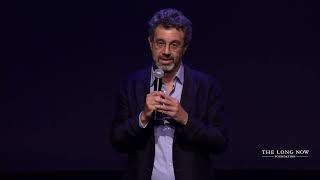
4:58Designing Institutions for Belonging: Mark Bonchek on What the Internet Promised
In this five-minute Ignite talk for the Long Now Foundation, Mark Bonchek asks why the internet, which once seemed poised to create community and connection, has not delivered a widespread sense of be
 5:07
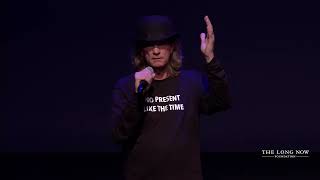
5:07Building a Solar Metric Clock: Mike Olson on Decimal Time and "True" Noon
In this five-minute Ignite talk for the Long Now Foundation, Mike Olson asks why time is the one everyday measurement that never went metric. They describe building a working decimal clock that also t
 5:13
5:13What Is Plurality? Rose Bloomin on Cooperation Across Difference
In this five-minute Ignite talk for the Long Now Foundation, Rose Bloomin asks how democracy can keep up with polarization, ungoverned social media, and now AI. Their answer is an emerging idea called
 4:47
4:47Keeping a 3,000-Year-Old Chalk Horse White: Long Now London and the Uffington Horse
In this five-minute Ignite talk, Christopher Daniel of Long Now London asks what it takes for something to last for millennia. His example is the White Horse of Uffington, a chalk figure on an English
 1:01:59
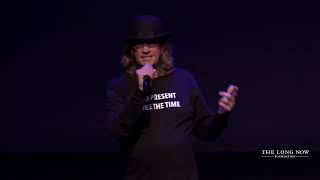
Eleven Five-Minute Visions of the Long Term: Long Now's 2024 Member Ignite Talks
The Long Now Foundation's fifth Ignite evening gave eleven members five minutes each to make a case about long-term thinking. The topics ranged from a metric clock on a desk to a DNA archive bound for